The Wizard of Oz is one of the most accessible movies in history. If you want to watch it at home, you can. It’s currently streaming on HBO Max and available for purchase on DVD, Blu-ray, or 4K. You can rent it on every major platform that offers digital movies. It remains in frequent rotation on cable television, too.
All of those versions offer a carefully preserved cut of the old film; the 4K disc, which I own, boasts a handsomely restored print scanned at 8K. It looks great. But none of The Wizard of Oz’s home video options, even that 4K, can give modern audiences a taste of what people felt in 1939 when they saw, for the very first time, that mid-movie transition from sepia tones to three-strip Technicolor.
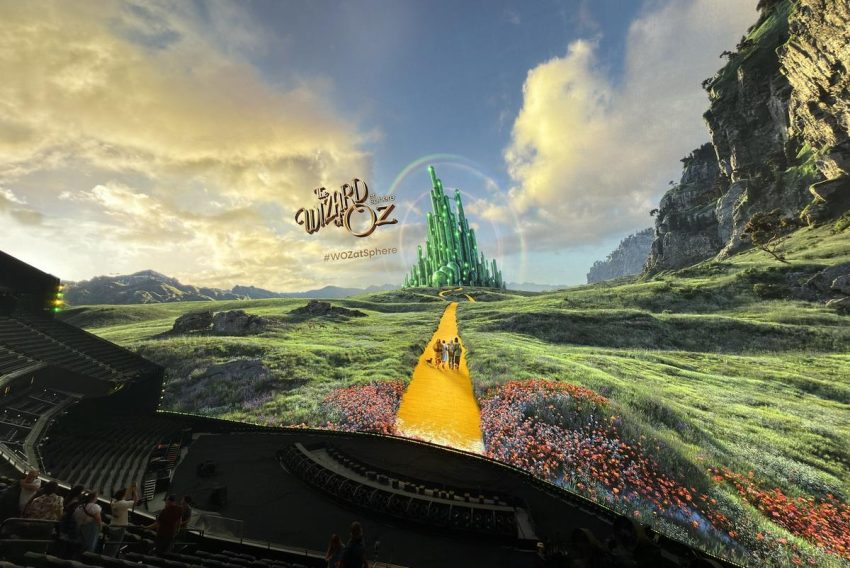
The best argument for the version of The Wizard of Oz now playing at Sphere in Las Vegas is that it gives contemporary viewers a taste of that feeling. The Wizard of Oz at Sphere, which is primarily a concert venue, is not faithful to the text of the 1939 Wizard of Oz; it’s 27 minutes shorter and contains many scenes altered and expanded by artificial intelligence to fit the largest 16K LED screen in the world. But parts of Sphere’s Oz may be more faithful to the feeling of seeing The Wizard of Oz in 1939 than anything else you will find on the market.
READ MORE: Underrated Remakes That Deserve More Love
Their print contains moments that are truly astonishing. The first image to take full advantage of its massive screen, the The Wizard of Oz logo against a cloudy sky, sparked a collective gasp from my audience. When was the last time a movie’s title card did that? Whatever one thinks of this particular version of The Wizard of Oz, individual sequences are so effective they suggest Sphere itself holds the potential to be the greatest venue for movies in the entire world.
The best way to appreciate Sphere’s Oz is as its own unique creation: Not The Wizard of Oz by Victor Fleming, but The Wizard of Oz at Sphere, its onscreen title in its end credits and the name branded on all the merchandise stocked in Sphere’s many gift shops. Once you make that key distinction, it’s easier to appreciate it as a breakthrough in film exhibition, rather than dismiss it out of hand as a bastardization of a cinema classic.
The story remains the same: Dorothy Gale of Kansas (Judy Garland) and her little dog Toto gets swept up by a twister and sent to the magical Land of Oz. Once she drops a house on the Wicked Witch of the East, the Wicked Witch of the West (Margaret Hamilton) swears revenge, which sets Dorothy off on a quest for the Emerald City, where she hopes the Wizard (Frank Morgan) will send her home — a location, I’m told, there’s no place like.
While the plot line remains unchanged, every single image that appears on Sphere’s 160,000-square-foot screen has been altered in some way. According to a report in The New York Times, Sphere “in partnership with Google, used various A.I. tools to create” their Wizard of Oz. The alterations were broadly about blowing up the original frames “to make the original movie big enough to fill the venue’s massive screen.” In practice, that meant doing things like adding legs to Dorothy “for a scene that was previously a close-up” and inserting Uncle Henry into scenes set at the Gale farmhouse, where he “was often off-camera” in the 1939 theatrical cut.
How does it look? Occasionally dazzling and occasionally off-putting. One of the curious aspects of The Wizard of Oz at Sphere is that some additions are made with great care and thoughtfulness, while others look distractingly unpolished. For example, I was genuinely moved by a moment during “Over the Rainbow” when Dorothy sings about birds flying way up high, and eagle-eyed viewers who craned their necks to view the apex of Sphere’s massive dome at just the right point in the tune would see a flock of birds soaring overheard — and Garland’s eyes seemingly tracking them as they swept through the artificial sky.
That scene gave me chills. Later, though, I couldn’t stop staring at one of the women attending to the Cowardly Lion during “The Merry Old Land of Oz.” Something about her seemed … off. Eventually, I realized that she was boomeranging a very brief movement back and forth in a stilted loop, like a shoddy Instagram story. That gave me the creeps.
On the other hand, I was completely astounded by The Wizard of Oz’s big tornado sequence, which utilizes massive fans, fog machines, and even leaves made out of tissue paper to simulate the experience of being caught in a massive windstorm. The effect is borderline overwhelming. I got smacked in the face with a leaf, and my wife’s hair was whipping around so hard she could barely see. When the wind finally died down and Dorothy landed in Oz, the entire audience — myself included — burst into spontaneous applause.
The scenes featuring the Wizard’s enormous floating green head were also impressive. His huge emerald cranium loomed over the audience, and his ominous pronouncements were augmented in the theater by plumes of real fire. The combined effect essentially puts the viewer into Dorothy’s ruby red shoes and lets you feel what it would be like to have this terrifying visage order you to kill a witch and steal her broom.
I suppose I could be outraged about the desecration of this masterpiece. And if the Sphere was the only place to watch The Wizard of Oz in 2026, I’d probably feel that way. But with the original Wizard of Oz still widely available, I saw The Wizard of Oz at Sphere as more of a showcase for the Sphere itself, which holds enormous promise as a venue for film exhibition.
The screen is just so big. It’s like IMAX on steroids plus 4DX on HGH, all rolled into one. (In addition to the epic windstorm, Sphere’s also got vibrating seats that rumble along with the Wicked Witch’s magic powers, and foam apples that rain down on the audience during the apple tree scene.)
Imagine what a great visual filmmaker like James Cameron or Christopher Nolan could do with this technology at their disposal. Imagine movies made specifically for Sphere, so that they don’t need artificial intelligence to reformat an old favorite’s aspect ratio. What would a Sphere-specific Star Wars look like? How about a Jurassic Park made for Sphere? Or a Spider-Man? Or a Top Gun? Or an Avatar?
The economics of making a blockbuster just for Sphere could be tricky; after all it could only play in that venue plus the handful of other Spheres the company is currently planning. On the other hand, the success of The Wizard of Oz at Sphere — where tickets start at $104 a piece and go up to $349 for the “Bad Witch Wicked Witch Ultimate VIP Experience” — suggests the right film in that venue could turn a huge profit. And it could making going to the theater to see a movie a true event in a way it never has before.
The mind boggles at the possibilities. There’s no place like home, but for seeing a movie on the largest scale possible, I can’t imagine anything topping Sphere.
20 Movies That Should Have Flopped That Became Massive Hits
These movies didn’t look like much on paper, then became some of the biggest hits ever.