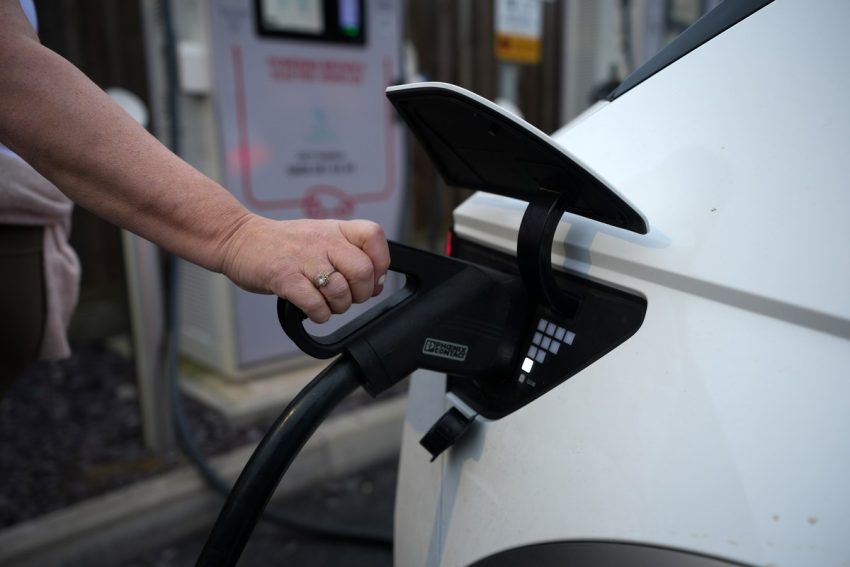
When people talk about the increase of electric vehicles on the roads in Washington state, there’s always a debate about whether or not the infrastructure is ready. To accommodate them.
It’s been my experience in the past that people who claim that Washington state’s electrical infrastructure isn’t prepared for the onslaught of electric vehicles. Don’t seem to have any kind of opinion about the proliferation of AI data centers that actually use more electricity.

There’s only one reason why I drive an EV. (OK, 2.)
1st it is overall cheaper to drive.
Second, it gives me the opportunity to mentally give the finger to every oil company.
Oil companies have been Happily taking my money for decades. Encouraging me to drive as far and as fast as I want. Before I stepped away from the gas pump, I was spending an average of $35.00 a week on gas. Keep in mind; this was seven years ago. When I switched to Electric, the average cost of fuel (electricity) per week went down to about $2.74.
That does not take into account. The cost of tires and other maintenance. But remember maintenance. But remember, maintenance on EVs is actually cheaper than maintenance on Internal combustion cars.

But what does that have to do with Washington state’s infrastructure in its preparedness for future electric vehicles.
Every year more charging stations are installed.
Tesla still has Tesla still has the largest number of. Charging stations for EVs in America. as of today, that totals out to 8440. That sounds like a lot of charging stations across the US, but in reality, that is only 9.8% of the total number of chargers available in the US.
To put this into perspective, there’s approximately 211,296 gas stations currently in the United States with around 862,428 nozzles that drivers have access to.
So, I was wondering what states are more prepared for electric vehicles than others? And as with a lot of these questions, yes, someone has done a study.
For the purposes of this article, when I talk about infrastructure, all I’m referring to is the number of charging stations. I’m not talking about the electrical infrastructure to support them.
So, what is the metric that we’re going to use?
Basically, our metric is how many EVs are for how many chargers? If I’m driving an EV in a particular state, how many other EV drivers am I competing with for a public charger?

Comparethemarket.com Did their research and here’s what they found.
The most difficult state to charge your EV in at a public charger is Hawaii, with 21 vehicles for every public charger.
New Jersey was the next in line for least prepared with 19.1 cars per public charger.
The number three most difficult state to charge your EV in, Arizona with 17.6 cars per public charger.
On the opposite spectrum.
Wyoming offers the greatest charger availability per car at 3.2 cars per charger.
North Dakota comes in #2 With 3.4 cars per public charger.
Ranking #3 on the list is the state of Maine with 4.3 cars per public charger.

Bringing it home to Washington State.
When I first started driving electric seven years ago, unless I was driving a Tesla, public charger availability was pretty sparse. (I was not driving a Tesla)
In Chelan County we had the advantage of the Chelan County PUD installing some public chargers (free of charge I might add) so in the course of my daily drive. I very seldom had a problem waiting to get public charging when I needed it. I did most of my charging at home.
Washington state does not rank as well in the availability of public chargers as I thought it might, showing up at #6. (Worst to best)

As of now, Washington has 9599. Public Charging stations in 3355 locations.
Washington has about 152,101. Registered EV drivers so that pencils out to approximately 15.8 EV drivers competing for a public charging station.
Looking at these numbers, you would think that there would be a lot of drivers sitting around waiting for a charging station to open up, but that has not been my personal experience over these years. There’s only been two or three times in the last seven years that I’ve actually had to wait for a charging station to open up, and then I was only waiting for about 10 to 15 minutes.
What you drive is based on what you need and what you can afford.
The choices I made and the reason I made them could be very different from yours.
The good thing is, is we are free to make those choices. OK
The Weirdest Things Washington Drivers Saw On The Side Of The Road
We asked, and you answered, here’s the top answers that our audience gave for the “Weirdest” things they’ve seen on the side of the road on their travels through the Evergreen State.
Gallery Credit: tsm/Timmy!