
America’s specialty crop growers are facing mounting financial pressure as higher costs and weak markets squeeze farm income.
New analysis from the American Farm Bureau Federation said fruit, vegetable, potato, tree nut and other specialty crop producers continue to struggle with below-breakeven prices, rising labor and input costs, and shrinking acreage. Farm Bureau estimates growers of six representative specialty crops lost more than $7 billion in 2025, while assistance through the Assistance for Specialty Crop Farmers program covered only a fraction of those losses.

The Extent Of The Challenges For Specialty Crop Growers Can Be Hard To Pinpoint
Market conditions in 2026 remain challenging, with potato, apple and wine grape producers among those still facing unprofitable returns; and those losses are expected to deepen into 2027.
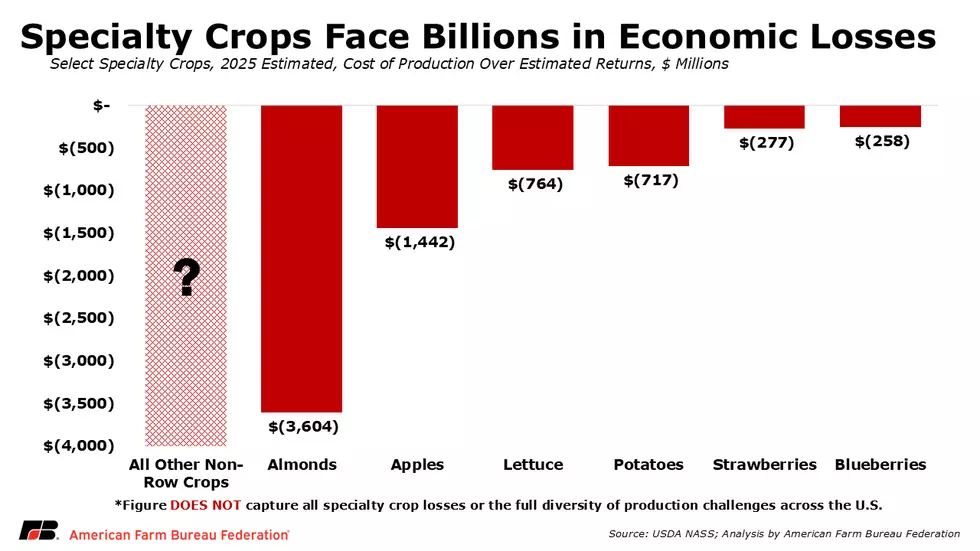
The full scale of losses for specialty crop producers face is difficult to quantify because consistent, timely public data on production costs and prices received by farmers is lacking for many crops. This data gap should not be mistaken for a lack of hardship. AFBF pointed out earlier this year that almonds, apples, blueberries, lettuce, potatoes and strawberries, six crops representing roughly one-quarter of specialty crop receipts, identified over $7 billion in estimated 2025 economic losses as labor, input, compliance and capital costs outpaced farm-level returns.
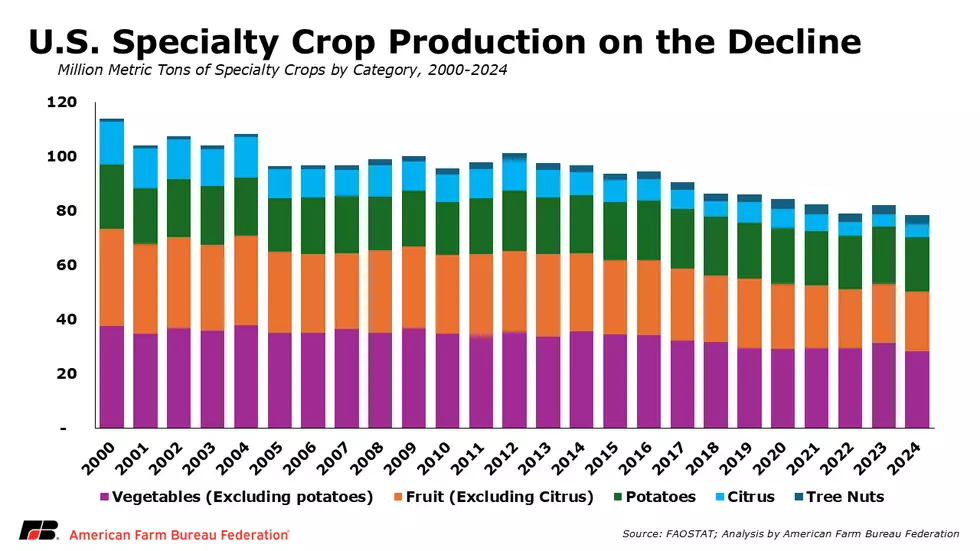
AFBF pointed out that recent economic conditions also point to a shrinking domestic specialty crop footprint. Since 2000, U.S. vegetable acreage has declined 41%, while production has fallen 24%, from 37 million metric tons to 28 million in 2024. Fruit acreage, including citrus, has declined 37%, while production has fallen 48%, from 51 million metric tons to 26 million. Tree nut production strengthened during years of stronger markets, peaking at 3.7 million metric tons in 2020, but had fallen to 3.2 million by 2024.
These declines reflect the cumulative effects of weak market returns, rising labor costs, import competition, weather, disease, and water constraints. Although they do not provide a direct measure of producer losses, they show how sustained financial and production pressures are shrinking domestic specialty crop capacity.
Its Not Just Row Crops That Are Struggling
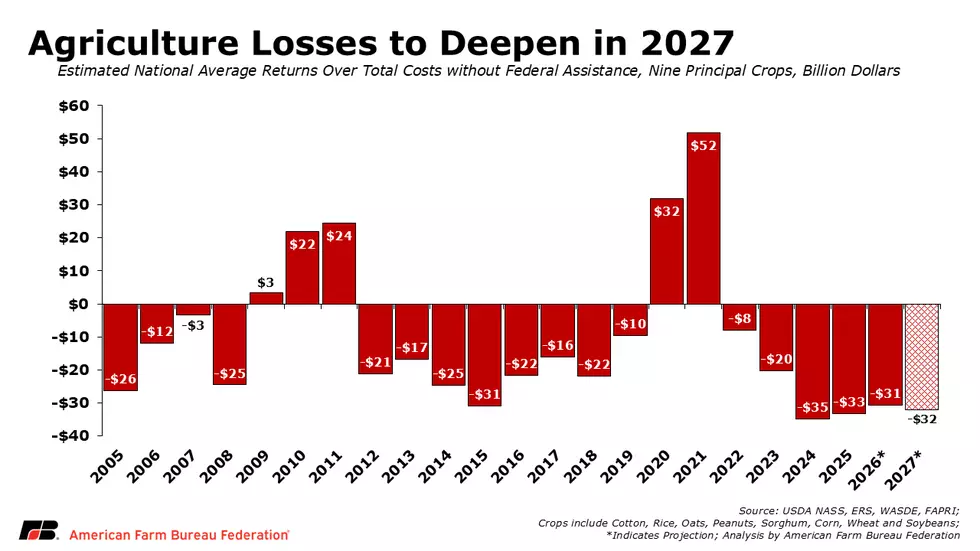
Using USDA-Economic Research Service cost of production data, World Agricultural Supply and Demand Estimates data, USDA-National Agricultural Statistics Service acreage data and Food and Agricultural Policy Research Institute projections, AFBF estimates national average returns over total costs, without federal assistance, at a $32 billion loss across nine principal crops [which does not includes specialty crops] in 2027, deepening from a $31 billion loss in 2026. These 2026 and 2027 figures represent projected, not realized, losses. Producers still have time to adjust acreage and input decisions, while weather, yields, market prices and other factors could change the final outcome. The 2027 estimate assumes crop prices remain at 2026 levels, though actual prices will vary in response to changing market conditions
Congress Needs To Act
The organization says fertilizer and fuel costs have climbed further amid global instability, adding to already tight margins.
Farm Bureau is urging Congress to approve additional economic assistance while advancing longer-term policies, including stronger risk management tools, agricultural labor reform and improved data collection to better support specialty crop producers. The group warns that without additional support, financial pressure could continue to shrink America’s domestic fruit and vegetable production.
If you have a story idea for the PNW Ag Network, call (509) 547-9791, or e-mail glenn.vaagen@townsquaremedia.com