Timothy was dead for a week in Seattle’s Discovery Park, lying halfway inside the door of his tent, when an officer investigating rumors of “a body in the woods” finally found him on March 31. The coroner determined he died of hypothermia and exposure.
Michael died alone in a tent, too, on April 9, in the middle of a crowded homeless encampment at Seattle’s Rotary View Park. A fire truck crew was flagged by someone who led them to Michael’s tent. They pulled him out to render aid, only to discover his body was already stiff. Michael’s pockets contained what was left of his fentanyl and crack cocaine. A responding officer put the drugs and some cash from Michael’s back pocket into an empty Narcan box sitting next to his body.
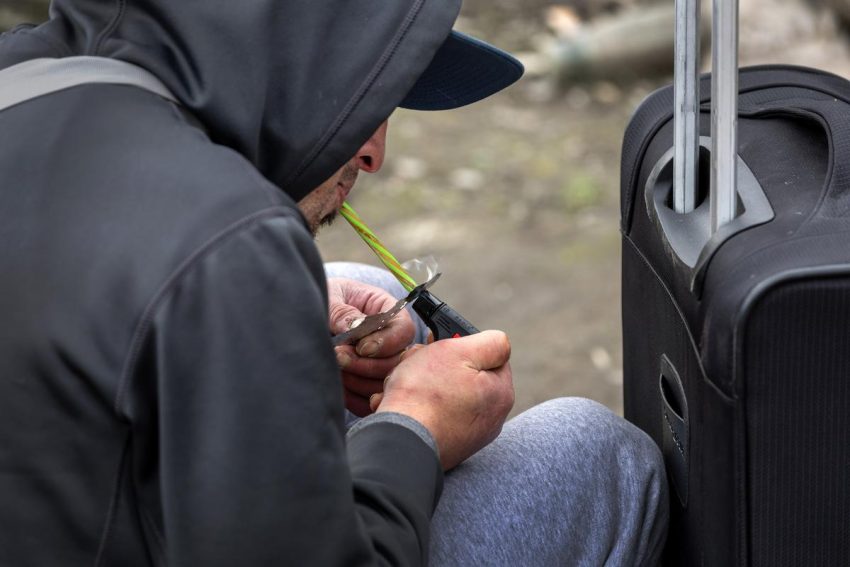
Shawn died on April 14, folded in half in his tent at Sunset Park in SeaTac, nose bleeding and face-down in a pool of his own vomit. Clutched in his right fist were a lighter and blowtorch, in his left a pack of cigarettes. The day before, Shawn had declined resources offered by a park employee.
Anna was found by a Seattle construction worker on April 27, collapsed on the floor inside a Honey Bucket. Her small purse was tied to the inside door and a plastic trash bag of clean clothes sat on the closed toilet seat. She’d overdosed on fentanyl.
On May 14, a 911 dispatcher picked up a call in Shoreline. The caller, a county worker, spoke calmly: “Yeah, there’s two guys laying on the ground with drug paraphernalia around them. One appears not to be breathing—his face is blue.” That’s where Maxwell died, on the sidewalk in front of Costco.
Brian didn’t do drugs, which is why his heartbroken sister was shocked when a coroner recorded meth in his system after he collapsed and died in March outside his Catholic Charities apartment in the Tri-Cities. Brian’s difficulty was mental illness, and his family carefully selected his apartment because it advertised staff care and a zero-tolerance policy for drugs. It was only after Brian’s death that they learned the rampant drug culture in his apartment is an open secret.
Linda owns a beautiful salon in downtown Spokane, but she’s closing after fifteen years. Her business’s first few years were marked by awards and glowing magazine articles, but she spent the last ten cleaning trash and human feces off her sidewalks, watching her clientele dwindle, and pleading with city officials and homeless housing operators to address the crime and disorder that enveloped her location.
Visitors to Spokane’s downtown public library are greeted inside by large signs proclaiming that “aggressive behavior will not be tolerated” and illustrated with examples of clipart figures assaulting each other, profane word bubbles, and a man harassing a woman. Police have been called to the library nearly 700 times in the last 18 months.
These incidents are shocking, and it’s hard to read them one after another. Yet, they’re a sampling of dozens more that have occurred in just the past several weeks in our state. Together, they tell a terrible story: Washington’s homelessness and drug policies are creating a culture of death and disorder.
This fact is documented in a data-rich report recently published by Normandy Park Mayor Eric Zimmerman. The report debunks the idea that Washington’s outsized homelessness crisis is caused by high rents and housing shortages. Instead, the data points squarely to permissive drug policies that have allowed a dramatic increase in proliferation here.
Zimmerman doesn’t pretend these policies were accidental: “We’ve made decisions … Compared to all the other states, we’ve been especially—especially—energetic at deconstructing the barriers that would typically stand between someone who wants to sell drugs and someone who wants to buy drugs. Washington has gone further than any other state in the country in removing the intermediary role that government has in blocking that transaction.”
This is no time to let politics, self-interest, or apathy sabotage solutions to this human crisis. It’s time for a major shift in homeless policy that puts life-saving and community-preserving law enforcement front-and-center, combined with relentless intervention focused on treatment and recovery.
Now. Today.
Marsha Michaelis is a research fellow for Discovery Institute’s Fix Homelessness initiative. She can be reached at mmichaelis@discovery.org.