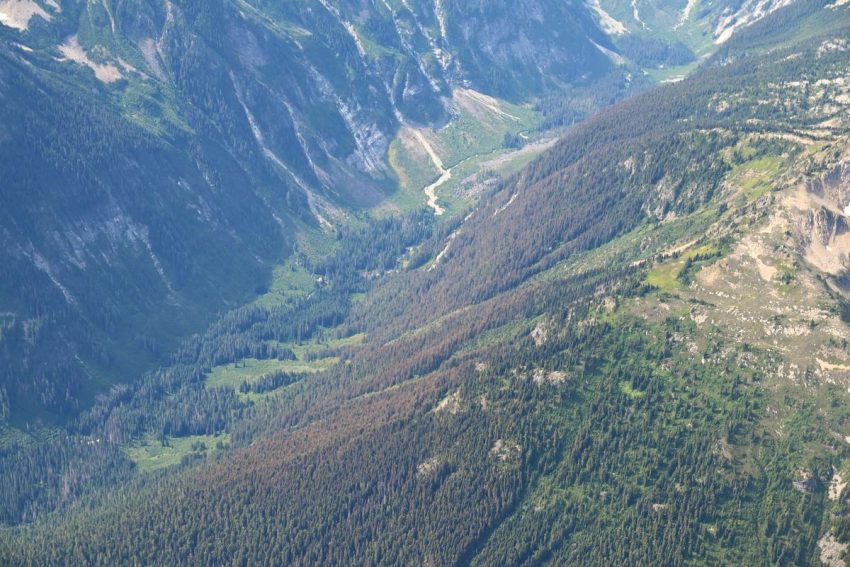
The Washington State Department of Natural Resources says this year’s aerial forest health survey covered only about 75% of the state’s forested land. This after staffing cuts at the U.S. Forest Service and the Washington Department of Fish and Wildlife disrupted the long-running program.
DNR says more than 391,000 acres showed signs of tree mortality, disease, or insect damage in 2025. Officials warn that number is likely an undercount because the survey was incomplete.
Photo: Washington DNR
We Need The Feds To Fund Our Effort
“One of my biggest concerns with the restructuring of the Forest Service is how changes to the federal workforce could negatively impact critical programs in Washington state,” Commissioner of Public Lands Dave Upthegrove said. “We value our strong, positive relationship with the Forest Service and are in close contact with them. It is imperative that federal leadership restore the positions necessary to ensure the continued success of our joint aerial survey.”
A major western spruce budworm outbreak continues spreading from Whatcom County east into Chelan and Okanogan counties, with unusual activity now reaching as far west as the Mount Baker area.
“The area affected by western spruce budworm has more than doubled in the last two years,” DNR Forest Entomologist Glenn Kohler said. “The unusual activity so far west in the Mt. Baker area is persisting. Spring sampling indicates we’re likely in for another year of damage and potential spread to new areas in 2026.”
Photo: Washington DNR
Areas with elevated trap catches in 2025 included locations in Kittitas, Klickitat, Yakima, and Okanogan counties. Larvae and egg masses were also observed in Klickitat County and in Lincoln County, near Grand Coulee. High trap-catch numbers do not always correlate with the exact location of future defoliation events.
“Despite the challenges this season faced, our team was able to gain an aerial view of a majority of our state’s forests including prioritizing the areas we knew had emergent forest health concerns,” said Washington State Forester George Geissler. “This year’s effort amidst dynamic capacity challenges displays our agency’s strong commitment to this annual data collection on our forests conditions to inform our management strategies.”
State officials say the future of the 80-year-old aerial survey program remains uncertain without restored federal staffing and funding.
Click Here to read the state’s entire report.
Photo: Washington DNR
If you have a story idea for the PNW Ag Network, call (509) 547-9791, or e-mail glenn.vaagen@townsquaremedia.com