I was barely a teenager when I encountered my first rattlesnake. It was a breezy late afternoon in California, and I was helping prepare the night’s campfire with a couple of other scouts. That’s when one of the chaperones and guides approached us with a beat-up pot, the kind that only comes out each summer to be used for camp chili.
We peered with adrenaline-fueled wonder inside at the tiny snake caught within. The guide taught us that the baby rattlesnake would be an unfortunate casualty, a necessary death to protect our young lives. We were, thankfully, spared from watching its execution. As a sensitive child, I’m surprised I didn’t cry over the small snake’s fate, though I remember feeling how unjust it felt.
Turns out I was right: baby rattlesnakes are in fact less dangerous than adults. A simple release further away from our camp would have been enough.
The annual spring rattlesnake warning in Tri-Cities misses one crucial fact
Eastern Washington is home to the only venomous snake in the state: the Western rattlesnake (more specifically, the Northern Pacific Rattlesnake). With a nasty reputation, each year news outlets remind us to watch out for rattlesnakes around April and May, when sightings typically peak across the state. Sometimes, we’ll even have a report of a sighting, such as the sighting on Skyline Trail in 2022.
But while most of us living here know there are rattlesnakes around, few of us actually have an understanding of where they live. That’s crucial information if you’re trying to stay safe (or if you’re seeking to spy one from a safe distance).
So where are rattlesnakes found in Tri-Cities?
Rattlesnakes are sighted in three core areas of Tri-Cities: Horse Heaven Hills, Badger Mountain, and Rattlesnake Mountain. All but one of the confirmed sightings on iNaturalist are in these three locales. That lone exception was found near Top of the World in South Richland. Benton County has also confirmed that there are rattlesnake populations at Candy Mountain, Hover, Horn Rapids, and Wallula Gap. Note that Pasco sees no rattlesnakes due to its geography.
Map of rattlesnake locations in Tri-Cities, WA
That means hikers and bikers are most at risk. However, keep in mind that these snakes don’t have maps and may wander into other areas that seem safe, like your backyard or garage. And if you smell cucumbers in your garage, see if someone’s making a salad – the old myth that rattlesnakes smell like cucumbers isn’t true. Instead, a stressed rattlesnake will give off a musky smell that will be distinctly unpleasant. If you smell something unusually off in your garage, it might be worth calling pest control to check for a snake or other creature.
A few more things to know about rattlesnakes in Tri-Cities
The rattlesnake is actually a peaceful species that doesn’t want to interact with humans, but that doesn’t mean fear of its bite isn’t warranted. If you want to peacefully co-exist with our local danger noodles, here’s a few things you should know.
Rattlesnakes are most active in the morning and evening, but will also be seen during the main part of the day if the weather is pleasantly warm (70-90°F). That said, it’s not unheard of to see a snake cross your path even if we’re in a moment of spring chill.
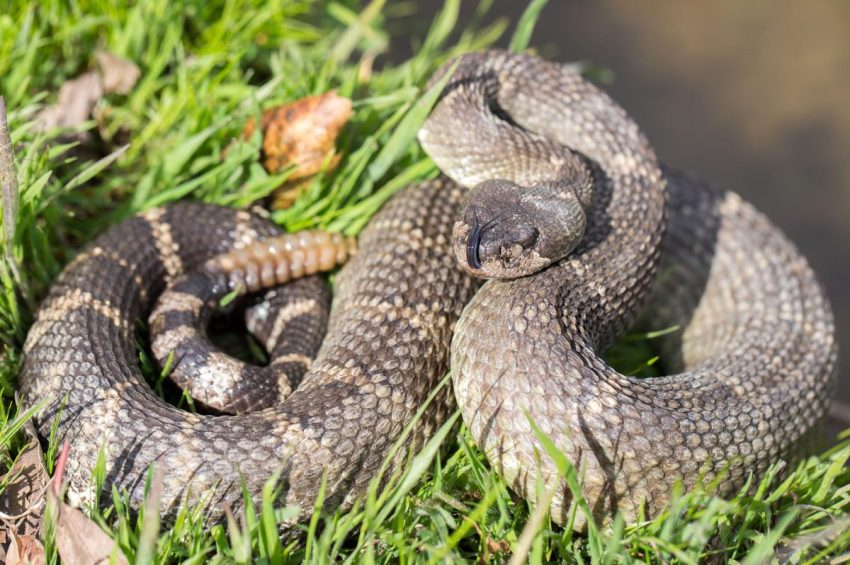
The easiest way to tell a rattlesnake from a harmless gopher snake is to check the head shape. Rattlesnake heads are triangular. The second best way is to notice whether the body is glossy (gopher snake) or dull (rattlesnake). While there are other things that tell our snakes apart, like scale pattern and body thickness, they’re not reliable indicators for the average person on the trail.
A Northern Pacific Rattlesnake curled up defensively. Notice the triangular, wedge-shaped head that widens before connecting to the neck. (Getty Images)
Rattlesnake warnings sound like a rattle (hear a sample in this educational video from the Washington Department of Fish and Wildlife), though the frequency can vary from hard and fast to slow and raspy. However, many rattlesnakes remain quiet and hope to be ignored. In fact I’ve yet to hear a live rattle myself.
Finally: rattlesnakes can strike about one-half their body length away. Our snakes are a little smaller (about three feet long at most), so just give any snakes a few feet of freedom. The standard recommendation is five feet, so just practice your COVID distancing.
Avoiding rattlesnake confrontation is pretty easy
While we share our land with rattlesnakes, the chance of encountering one while you’re out on the trail is fairly low. The WDFW recommends that you can keep that chance even lower by remaining on well-used trails, using a walking stick, and avoiding thick brush and low visibility areas.
If you do encounter a snake, you might instinctually freeze, but don’t panic. Look around until you locate the snake, and then back away from it several feet. Rattlesnakes are only likely to strike if they are cornered and cannot escape. They are not aggressive and will not chase you.
Don’t panic: a bite isn’t the end of the world
Accidents can still happen, so what do you do if you or someone else is bitten by a rattlesnake? First of all, stay calm: it’s not a death sentence. Most rattlesnake bites are “dry” and do not contain venom, and those that do are treatable if medical attention is sought promptly.
The National Capital Poison Center and WDFW advise the following: stay as calm as you can, avoid moving around, and call 911 or Poison Control at 1-800-222-1222 immediately. Clean the wound with soap and water if possible, and take off any constricting clothes or jewelry. Otherwise skip the dramatic things you’ve seen in movies and TV: no wound-sucking, no ice, no creams, and no tourniquet. If your dog is bitten, just go straight to the emergency vet, and let them know you’re coming if you can. Finally, don’t bother trying to capture the snake; treating the victim is more important and doctors will know what to do.
Can I just kill a rattlesnake if I run across one?
Unfortunately, many of us have an instinct to kill a creature that we are terrified of, be it snake, spider, or other potentially dangerous animals. And while animal lovers and conservationists like myself would implore you to find any other solution, there are occasions when the right answer is to kill the threat.
But is it legal to kill a rattlesnake in Washington?
Washington state law protects rattlesnakes as non-game wildlife. Still, under WAC 220-440-050, “it is permissible to kill wild animals engaged in the physical act of attacking a person.” However, you are expected to first consider options such as retreat from the area or wildlife removal services. A snake’s presence where you want to be is not enough: the snake must be actively attacking you at the time.
Living with rattlesnakes isn’t as terrifying as it sounds
The baby rattlesnake I first encountered was also my only known encounter in the wild with a rattlesnake, and that was only because it was captured and brought to me to see. That’s actually impressive, because I’ve lived in “rattlesnake country” my entire life. Through several moves across California, Utah, Texas, and Washington State, where I’ve been out hiking, camping, fishing, riding, and exploring for countless hours (including in places I shouldn’t have been), I’ve yet to hear or see a rattlesnake in my path. It’s highly likely that I’ve actually unknowingly crossed paths with several who simply remained hidden at a distance, or slithered away unseen.
The fact that Benton County only gets one or two reports of rattlesnake sightings a year also suggests that our local snakes follow the same pattern: stay out of the way of humans. We have a uniquely intimate relationship with the wilderness here in Tri-Cities, surrounded on all sides by wild areas, and even cut through the middle by the rivers that still teem with wildlife. They have learned to live with us, just as we’ve learned to live with them.
All it takes is a little awareness and understanding. Who knows, perhaps you’ll be lucky enough to spot a rattlesnake yourself one day and have a story to share for a lifetime.
Want to spot snakes this year? These Washington trails are well-known for snake-spotting.
If you like snakes, here are five snake-infested trails in Washington State
Gallery Credit: Rik Mikals